
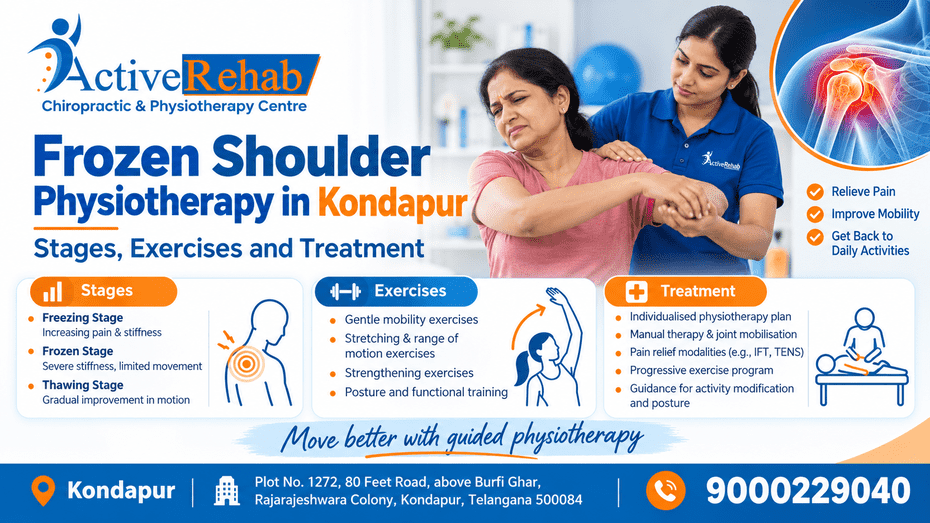
Are you finding it difficult to lift your arm, reach behind your back, comb your hair or wear clothes because of shoulder pain and stiffness? These problems may be signs of frozen shoulder, a condition that gradually restricts shoulder movement and can interfere with everyday activities.
Frozen shoulder, medically known as adhesive capsulitis, occurs when the connective tissue capsule surrounding the shoulder joint becomes inflamed and thickened, restricting movement. Symptoms often develop gradually and may last for months or longer.
For people looking for frozen shoulder physiotherapy in Kondapur, understanding the condition, its stages and the appropriate exercises is an important first step towards better shoulder function.
At ActiveRehab Chiropractic & Physiotherapy Centre, Kondapur, treatment planning can include an assessment of shoulder mobility, pain, muscle function and daily activities to help guide an appropriate rehabilitation programme.
What Is Frozen Shoulder?
Frozen shoulder is characterised by shoulder pain and a progressive loss of both active and passive movement. This means you may struggle to move your arm yourself, and another person may also find that your shoulder has limited movement when assisting you.
It is different from ordinary muscle soreness because the restriction often affects several directions of movement, especially rotating the arm outward and lifting it overhead.
Common Symptoms of Frozen Shoulder
You may experience:
- Pain when raising your arm above shoulder height.
- Difficulty reaching behind your back or fastening clothing.
- Shoulder stiffness after periods of inactivity.
- Pain that disturbs sleep, particularly when lying on the affected side.
- Difficulty combing your hair, bathing or reaching for objects.
- Gradually decreasing shoulder mobility.
These symptoms can overlap with rotator cuff injuries, arthritis and other shoulder conditions. A proper assessment is important before starting treatment.
What Are the Three Stages of Frozen Shoulder?
Frozen shoulder commonly progresses through three stages. The duration and severity of each stage vary from person to person, and not everyone follows exactly the same pattern.
1. Freezing Stage: Increasing Pain and Stiffness
In this stage, shoulder pain gradually increases and movement becomes more difficult. Pain may be particularly noticeable at night or during reaching activities.
What may help:
- Gentle, pain-limited shoulder movements.
- Appropriate activity modification.
- Comfortable positioning during sleep.
- Physiotherapy guidance to maintain available movement without aggravating symptoms.
Forceful stretching may worsen discomfort during this sensitive stage. Exercises should be adjusted to your symptoms and examination findings.
2. Frozen Stage: Significant Shoulder Stiffness
During this stage, pain may become less intense for some people, but stiffness can remain substantial. Everyday tasks such as dressing, washing your hair and reaching overhead may be difficult.
What may help:
- Gradual shoulder mobility exercises.
- Carefully progressed stretching where appropriate.
- Exercises for the shoulder blade and surrounding muscles.
- Functional training to make daily activities easier.
The goal is to improve movement progressively without repeatedly provoking significant pain.
3. Thawing Stage: Gradual Improvement in Movement
In the thawing stage, shoulder movement begins to improve gradually. Stiffness may continue, and rebuilding strength and confidence can take time.
What may help:
- Progressive range-of-motion exercises.
- Shoulder and shoulder-blade strengthening.
- Functional reaching exercises.
- Gradual return to household, work and recreational activities.
Recovery may take many months, and some people experience symptoms for several years. Consistent, appropriately tailored rehabilitation can help improve function, but the exact recovery time cannot be guaranteed.
Best Physiotherapy Exercises for Frozen Shoulder
The right exercises depend on your current pain level, the stage of the condition and the amount of movement available. Start gently and avoid forcing your shoulder through sharp pain.
1. Pendulum Exercise
This exercise allows gentle shoulder movement with support from your body position.
How to do it:
- Stand beside a stable table or chair and support yourself with your unaffected arm.
- Lean forward slightly, allowing the affected arm to hang comfortably.
- Gently shift your body to create small arm movements.
- Move forwards and backwards, then side to side, if comfortable.
- Continue for approximately 30–60 seconds.
Keep the movement relaxed rather than actively swinging the arm forcefully.
2. Table Slides
Table slides can help practise forward shoulder movement with the assistance of a flat surface.
How to do it:
- Sit facing a table with the affected hand resting on a towel.
- Slowly slide the hand forward while leaning your body slightly forward.
- Stop before the movement becomes sharply painful.
- Return to the starting position slowly.
- Repeat 5–10 times if comfortable.
Use a smaller movement range if your shoulder is highly sensitive.
3. Assisted External Rotation
This exercise helps maintain or gradually improve outward shoulder rotation.
How to do it:
- Sit or stand with your elbow bent at approximately 90 degrees and tucked near your side.
- Hold a light stick with both hands.
- Use the unaffected arm to gently guide the affected forearm outward.
- Stop at a comfortable stretch rather than forcing the joint.
- Hold briefly, then return slowly.
Begin with a small range. A physiotherapist can determine whether this exercise is suitable for your current stage.
4. Shoulder Blade Squeezes
Shoulder blade exercises help maintain control of the muscles around the upper back without requiring large shoulder movements.
How to do it:
- Sit or stand upright with your arms relaxed.
- Gently draw your shoulder blades towards each other.
- Avoid shrugging your shoulders or arching your lower back.
- Hold for 3–5 seconds.
- Relax and repeat 8–10 times.
Stop if the movement increases your shoulder pain.
Important Exercise Precautions
- Do not force your arm overhead or push through sharp pain.
- Avoid aggressive stretching during a painful flare-up.
- Reduce the range or repetitions if symptoms remain noticeably worse afterwards.
- Seek professional guidance if you are uncertain whether the problem is frozen shoulder or another condition.
These exercises are general examples, not a substitute for an individual assessment.
How Does Frozen Shoulder Physiotherapy Work?
A physiotherapy programme should be tailored to your symptoms and functional limitations rather than following the same routine for everyone.
1. Shoulder Assessment
The clinician may assess your pain, shoulder range of motion, strength, functional limitations and medical history. The examination helps determine whether the symptoms are consistent with frozen shoulder or suggest another diagnosis.
2. Pain Management and Activity Advice
Your physiotherapist can advise on comfortable movement, sleeping positions and modifications to work or household activities. The aim is to keep you active without repeatedly aggravating the shoulder.
3. Mobility and Stretching Exercises
Gentle movements may be appropriate early on, while more sustained stretching may be introduced when pain and irritability allow. Exercise intensity should progress according to your response.
4. Progressive Strengthening
As movement and pain improve, exercises may be introduced for the rotator cuff and shoulder-blade muscles. Strengthening supports the return to everyday tasks and recreational activities.
5. Home Exercise Programme
A manageable home programme can help you practise movements between appointments. Your physiotherapist can adjust the exercises if your pain increases or your mobility changes.
Can Frozen Shoulder Be Treated Without Surgery?
Many people with frozen shoulder improve with non-surgical management. Depending on the diagnosis and severity, treatment may include physiotherapy, home exercises, appropriate pain relief recommended by a healthcare professional, or medical interventions such as a corticosteroid injection.
Surgery is not usually the first treatment. If significant stiffness persists despite appropriate conservative care, a specialist may discuss additional options.
Chiropractic or manual therapy may sometimes be considered as part of a broader musculoskeletal care plan, but it should not replace a proper shoulder assessment or appropriate medical management. Forceful manipulation of a painful, stiff shoulder is not advisable.
How Long Does Frozen Shoulder Take to Recover?
There is no single recovery timeline for everyone. Some people improve over several months, while others experience stiffness and functional limitations for a year or longer.
Recovery depends on factors such as:
- The stage and severity of the condition.
- How much movement is restricted.
- Other health conditions.
- Sleep, activity levels and daily demands.
- The suitability and consistency of the treatment programme.
Progress is better assessed through changes in pain, movement and daily function than by counting the number of physiotherapy sessions alone.
When Should You Seek Medical Assessment?
Arrange an assessment if shoulder pain or stiffness is worsening, disrupting sleep, limiting daily activities or not improving.
Seek urgent medical care if shoulder pain follows a major injury, the shoulder appears deformed, you cannot move your arm after an injury, or you develop a hot, red, swollen shoulder with fever. Chest discomfort, breathlessness, sweating or pain spreading to the jaw or arm may indicate a medical emergency.
Frozen shoulder symptoms can resemble other conditions, so do not assume every stiff shoulder is adhesive capsulitis.
Frozen Shoulder Physiotherapy in Kondapur at ActiveRehab
If shoulder stiffness is affecting your work, sleep or daily routine, a professional assessment can help identify the likely cause and guide the next steps.
ActiveRehab Chiropractic & Physiotherapy Centre provides physiotherapy and rehabilitation services in Kondapur, Hyderabad. Treatment recommendations should be based on your examination findings, symptoms and functional goals.
Why consider an assessment at ActiveRehab?
- Individual assessment of shoulder movement and functional limitations.
- Guidance on appropriate mobility and strengthening exercises.
- Advice on activity modification and home rehabilitation.
- Progress monitoring and adjustment of the treatment plan.
Book an Appointment in Kondapur
ActiveRehab Chiropractic & Physiotherapy Centre
Address: Plot No. 1272, 80 Feet Road, above Burfi Ghar, Rajarajeshwara Colony, Kondapur, Telangana 500084.
Call or WhatsApp: +91 9000229040
Website: https://activerehab.in/
Contact the clinic to enquire about an appointment for shoulder pain and stiffness.
Frequently Asked Questions
1. Can physiotherapy cure frozen shoulder?
Physiotherapy can help improve shoulder movement, manage symptoms and restore daily function. Recovery varies, and some people require additional medical treatment.
2. Which exercise is best for frozen shoulder?
There is no single best exercise for everyone. Pendulum movements, table slides and assisted rotation may be suitable for some people, depending on their pain and mobility. A physiotherapist can help select the appropriate exercises.
3. Should I stretch a frozen shoulder every day?
Gentle, appropriate exercises may be performed regularly, but stretching intensity matters. Avoid forcing the shoulder or repeatedly provoking significant pain. Follow the frequency and dosage recommended for your condition.
4. Can frozen shoulder improve without surgery?
Yes. Many cases improve over time with non-surgical care, including appropriate exercises and symptom management. Some people need medical interventions if pain or stiffness remains severe.
5. Is frozen shoulder the same as a rotator cuff injury?
No. Frozen shoulder primarily restricts the shoulder joint’s movement, including movement assisted by another person. Rotator cuff problems may cause pain and weakness, but the pattern of movement restriction can differ. Clinical assessment helps distinguish these conditions.
6. When should I visit a physiotherapist in Kondapur?
Consider an assessment when shoulder stiffness, pain or restricted movement begins affecting sleep, dressing, work or other everyday activities, particularly if symptoms are worsening or persistent.
Conclusion
Frozen shoulder can make simple activities difficult, but an appropriate treatment plan can help you manage symptoms and gradually restore function. Understanding the stage of the condition, choosing suitable exercises and progressing at the right pace are important parts of rehabilitation.
If you are searching for frozen shoulder physiotherapy in Kondapur, contact ActiveRehab Chiropractic & Physiotherapy Centre to enquire about an assessment and discuss suitable treatment options for your shoulder.
Medical information note: This article is for general educational purposes and does not replace an individual medical assessment or diagnosis.


