
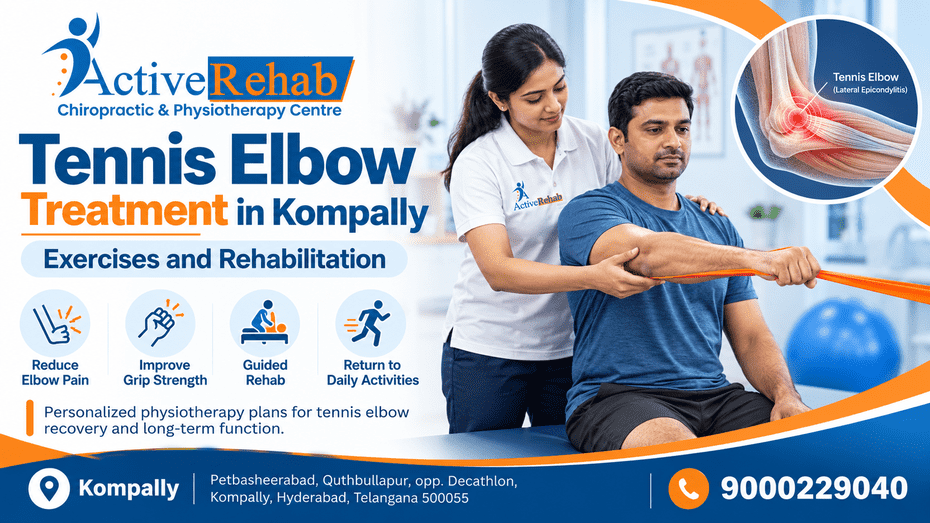
Does your elbow hurt when lifting a water bottle, carrying a shopping bag, turning a doorknob or using a computer mouse? Persistent pain on the outer side of the elbow may be associated with tennis elbow, a condition that affects athletes, office workers, gym-goers and people performing repetitive hand movements.
Tennis elbow, medically known as lateral elbow tendinopathy, affects the tendon connecting the forearm muscles to the outer part of the elbow. Despite its name, you do not need to play tennis to develop this condition.
If you are searching for tennis elbow treatment in Kompally, understanding the cause of your symptoms and following an appropriate rehabilitation programme can help improve grip strength and everyday function.
At ActiveRehab Chiropractic & Physiotherapy Centre, Kompally, an assessment can help determine whether your elbow symptoms may benefit from physiotherapy, progressive strengthening and other suitable conservative treatment options.
What Is Tennis Elbow?
Tennis elbow commonly develops when the tendon responsible for extending the wrist is repeatedly overloaded. This may occur through repetitive gripping, lifting, racquet sports, weight training, manual work or prolonged computer use.
Symptoms may develop gradually rather than following a single injury. The discomfort often becomes more noticeable during activities that require gripping or wrist extension.
Common Symptoms of Tennis Elbow
You may experience:
- Pain or tenderness around the outside of the elbow.
- Discomfort while gripping objects or shaking hands.
- Pain when lifting a cup or bag, particularly with the palm facing down.
- Reduced grip strength because of pain.
- Discomfort during wrist extension or repetitive forearm activity.
- Symptoms that worsen after work, sports or gym sessions.
Not every case of elbow pain is tennis elbow. Nerve irritation, joint problems and other tendon conditions can cause similar symptoms, so an appropriate assessment is important.
What Causes Tennis Elbow?
Tennis elbow is often associated with repeated loading of the forearm muscles and their tendons.
1. Repetitive Computer Work
Long periods of typing, mouse use or repetitive wrist movements may aggravate elbow symptoms in some people, especially when combined with sustained gripping or an unsuitable workstation setup.
2. Gym Training and Weightlifting
Exercises involving heavy gripping, wrist extension or repeated pulling may overload sensitive tendons if the training load increases too quickly.
3. Racquet Sports
Tennis, badminton and other racquet sports involve repeated gripping and forearm movements. Training volume, technique, equipment and recovery may influence tendon loading.
4. Manual Work and Household Activities
Painting, carrying tools, gardening and lifting objects can place repeated demands on the forearm tendons.
5. Sudden Changes in Activity
Increasing exercise intensity, work demands or training frequency too quickly may contribute to symptoms.
Identifying the activities that aggravate your elbow is an important part of planning treatment.
How Is Tennis Elbow Diagnosed?
A physiotherapist or appropriately qualified healthcare professional may assess your symptoms, medical history, elbow movement, grip strength and response to specific resisted movements.
The assessment may include:
- Checking where the pain is located.
- Assessing wrist and elbow movement.
- Testing grip strength and functional activities.
- Reviewing work, sports and exercise demands.
- Screening for signs of nerve involvement or other possible causes.
Imaging is not routinely required for typical tennis elbow, but further investigation may be recommended if the diagnosis is unclear, symptoms follow significant trauma or another condition is suspected.
Tennis Elbow Treatment in Kompally: What Are the Options?
Treatment usually focuses on reducing aggravating loads and progressively rebuilding the affected tendon’s ability to tolerate activity.
1. Activity Modification
Temporarily adjust activities that trigger significant pain rather than stopping all arm movement.
Examples include:
- Reducing heavy gripping or repetitive lifting.
- Adjusting gym exercises and training volume.
- Taking regular breaks during repetitive work.
- Using both hands when practical to distribute the load.
As symptoms improve, activities can be gradually reintroduced.
2. Progressive Strengthening Exercises
Progressive strengthening is an important component of rehabilitation for many people with tennis elbow. Exercise selection and resistance should be adjusted to your symptoms and current capacity.
3. Manual Therapy as an Adjunct
A clinician may use appropriate manual therapy to help manage symptoms or improve movement when indicated. Manual treatment should support, rather than replace, a suitable exercise and activity-management programme.
4. Workstation and Sports Modifications
Adjustments to the way you work, grip equipment or perform exercises may reduce unnecessary strain. These changes are particularly relevant when symptoms are associated with repetitive occupational or sporting tasks.
5. Medical Review When Needed
If symptoms are severe, persistent or atypical, a medical assessment may be appropriate. Additional treatment options can be discussed depending on the diagnosis and response to conservative care.
Best Exercises for Tennis Elbow
The following exercises are general examples and may not be suitable for everyone. Begin with comfortable resistance and a manageable range. A physiotherapist can help determine the correct starting level.
Exercise 1: Isometric Wrist Extension
This exercise activates the wrist extensor muscles without requiring repeated wrist movement.
How to do it:
- Sit comfortably with your forearm supported on a table.
- Keep your wrist in a neutral position.
- Place your unaffected hand over the back of the affected hand.
- Gently try to lift the affected wrist while your other hand prevents movement.
- Hold for around 10–20 seconds, breathing normally.
- Relax and repeat a few times if comfortable.
Begin with gentle effort. Reduce the intensity if your elbow pain increases significantly.
Exercise 2: Wrist Extension With Light Resistance
This exercise can help progressively strengthen the forearm muscles.
How to do it:
- Sit with your forearm supported and your hand positioned just beyond the edge of a table.
- Hold a very light dumbbell or suitable weight.
- Slowly lift your wrist upwards.
- Lower it under control.
- Start with a small number of repetitions and increase gradually as tolerated.
Use resistance that allows controlled movement without sharp pain.
Exercise 3: Slow Wrist-Lowering Exercise
Controlled wrist lowering, sometimes called eccentric wrist extension, may be included in a rehabilitation programme.
How to do it:
- Support your forearm on a table with your palm facing down.
- Use your unaffected hand to help position the affected wrist upwards.
- Slowly lower the affected wrist using its own muscles.
- Use the other hand to assist with returning to the starting position.
- Repeat only if the movement is comfortable and appropriate for your symptoms.
Resistance and repetitions should be progressed according to your response.
Exercise 4: Gentle Forearm Stretch
Stretching may help some people feel less restricted, although it should not replace progressive strengthening.
How to do it:
- Extend your affected arm in front of you with your elbow straight but not forcefully locked.
- Gently bend your wrist downwards.
- Use your other hand to apply light pressure until you feel a mild stretch.
- Hold briefly while breathing normally.
- Release slowly.
Do not push into sharp pain, tingling or numbness.
Exercise 5: Gradual Grip Strengthening
Grip exercises may be useful when gripping activities are painful or weak, but the resistance must be appropriate.
How to do it:
- Hold a soft foam ball or rolled towel.
- Squeeze gently without straining.
- Hold for a few seconds, then relax.
- Repeat a few times if comfortable.
- Increase the effort gradually as your symptoms allow.
If gripping consistently increases pain, reduce the resistance or seek guidance before continuing.
How Often Should You Exercise?
There is no single schedule that suits every case. Your starting level should depend on pain, irritability, strength and the demands of your daily activities.
Start with a manageable amount of exercise, monitor your response later that day and the following morning, and progress gradually. If symptoms become substantially worse or remain aggravated, reduce the load and seek professional advice.
Can Chiropractic Care Help Tennis Elbow?
People often search for a chiropractor when elbow pain affects gripping, lifting or sports. Chiropractic care generally focuses on the musculoskeletal system, but evidence for spinal manipulation as a direct treatment for tennis elbow is limited.
For tennis elbow, local tendon rehabilitation and progressive strengthening are central considerations. A suitably qualified clinician may assess movement across the elbow, wrist, shoulder and neck when relevant, while checking whether symptoms could be related to another condition.
Manual therapy may be considered as an adjunct in selected cases, but it should not be presented as a guaranteed cure for tendon problems. Treatment should be based on examination findings and individual needs.
How Long Does Tennis Elbow Take to Recover?
Recovery varies depending on symptom severity, duration, activity demands and how the tendon responds to progressive loading.
Some people improve over several weeks, while persistent symptoms may take several months or longer to settle. There is no guaranteed recovery time or fixed number of treatment sessions.
Factors that may influence recovery include:
- How long symptoms have been present.
- The demands of work, sports and household activities.
- Whether aggravating loads can be modified.
- Consistency with an appropriate strengthening programme.
- Other health conditions or alternative causes of elbow pain.
Progress can be monitored by checking pain during gripping, lifting tolerance, strength and the ability to return to normal activities.
When Should You Seek Professional Help?
Consider an assessment if elbow pain persists, interferes with work or daily activities, reduces your grip strength or does not improve with reasonable activity modification.
Seek prompt medical attention if elbow pain follows a significant injury, there is obvious deformity, the elbow becomes hot and swollen with fever, or you develop sudden marked weakness or persistent numbness.
Pain spreading from the neck, tingling in the hand or symptoms that do not fit the usual pattern of tennis elbow may require further assessment.
Tennis Elbow Treatment in Kompally at ActiveRehab
If elbow pain is affecting your work, gym routine or everyday activities, an individual assessment can help clarify the likely cause and identify appropriate next steps.
ActiveRehab Chiropractic & Physiotherapy Centre offers musculoskeletal care and rehabilitation services in Kompally, Hyderabad. Depending on your assessment, care may include advice on activity modification, progressive exercises and appropriate physiotherapy interventions.
Why Consider an Assessment?
- Assessment of elbow movement, grip and functional limitations.
- Guidance on suitable strengthening exercises.
- Advice on managing work, sports and gym activities.
- A rehabilitation plan that can be adjusted as symptoms change.
- Referral for medical evaluation when findings suggest that it is needed.
Book an Appointment in Kompally
ActiveRehab Chiropractic & Physiotherapy Centre
Address: Petbasheerabad, Quthbullapur, opposite Decathlon, Kompally, Hyderabad, Telangana 500055.
Call or WhatsApp: +91 9000229040
Website: https://activerehab.in/
Contact the clinic to enquire about an assessment for elbow pain and discuss suitable rehabilitation options.
Frequently Asked Questions
1. Can tennis elbow heal without surgery?
Many people improve with conservative care, including activity modification and progressive strengthening. Surgery is generally considered only in selected cases when symptoms remain persistent despite appropriate treatment.
2. Is physiotherapy effective for tennis elbow?
A structured rehabilitation programme can help improve strength, function and tolerance for daily activities. The programme should be tailored to the individual’s symptoms and physical demands.
3. Should I stop going to the gym if I have tennis elbow?
Not necessarily. You may need to modify exercises that involve painful gripping, heavy pulling or wrist extension. A gradual return based on symptoms and capacity is generally preferable to repeatedly provoking pain.
4. Can a chiropractor treat tennis elbow?
A chiropractor may assess relevant musculoskeletal problems and, depending on their qualifications and scope of practice, offer appropriate conservative care. For tennis elbow specifically, progressive tendon loading and activity management are important; spinal adjustments should not be presented as a proven standalone cure.
5. Is tennis elbow caused only by playing tennis?
No. It can occur in people who perform repetitive gripping, lifting, computer work, manual tasks, gym exercises or other activities that load the forearm tendons.
6. When should I visit ActiveRehab in Kompally?
Consider arranging an assessment if elbow pain is persistent, limits gripping or lifting, affects sports or work, or does not improve after modifying aggravating activities.
Conclusion
Tennis elbow can make everyday tasks such as lifting, gripping and using a computer uncomfortable. Identifying the likely cause, adjusting aggravating activities and gradually rebuilding tendon strength can support recovery.
If you are searching for tennis elbow treatment in Kompally, contact ActiveRehab Chiropractic & Physiotherapy Centre to enquire about an assessment and suitable rehabilitation options.
This article is for general educational purposes and does not replace an individual medical assessment or diagnosis.


