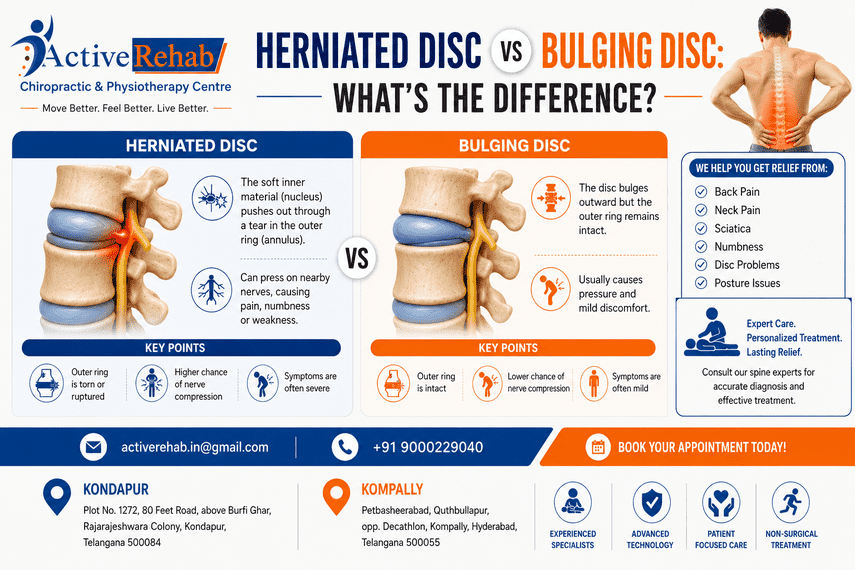
Many people use the terms herniated disc and bulging disc interchangeably, but they are not the same condition. A bulging disc occurs when the disc extends beyond its normal boundary without rupturing, while a herniated disc happens when the inner gel-like material pushes through a tear in the outer layer. Both conditions can cause back pain, neck pain, or sciatica, but they differ in severity and treatment approaches.
Are You Experiencing Persistent Back or Neck Pain?
📞 Call or WhatsApp: 9000229040
Active Rehab Chiropractic & Physiotherapy Centre
✔ Non-Surgical Spine Care
✔ Chiropractic Treatment
✔ Physiotherapy & Rehabilitation
✔ Personalized Recovery Plans
Back pain and neck pain are among the most common reasons people visit a healthcare professional. MRI reports often mention terms like bulging disc, disc protrusion, or herniated disc, leaving many patients confused.
Understanding the difference between these conditions is important because the severity, symptoms, and treatment options may vary. Fortunately, many disc-related problems can be managed successfully with conservative, non-surgical care.
What Is an Intervertebral Disc?
The spine is made up of vertebrae separated by intervertebral discs, which act as cushions and shock absorbers.
Each disc has two parts:
Outer Layer (Annulus Fibrosus)
A tough, fibrous ring that provides strength and stability.
Inner Core (Nucleus Pulposus)
A soft, gel-like center that absorbs pressure during movement.
Damage to either part can lead to disc problems.
What Is a Bulging Disc?
A bulging disc occurs when the disc extends beyond its normal boundary but the outer layer remains intact.
Characteristics
- Disc bulges outward evenly.
- Outer layer remains unbroken.
- Often develops gradually.
- May not produce symptoms.
- Frequently associated with age-related degeneration.
Many people have bulging discs on MRI without experiencing pain.
What Is a Herniated Disc?
A herniated disc occurs when a tear develops in the outer layer, allowing the inner gel material to push outward.
This can irritate nearby spinal nerves and produce more noticeable symptoms.
Characteristics
- Tear in the outer disc layer
- Inner disc material protrudes outward
- Greater likelihood of nerve compression
- Usually more painful than a simple bulging disc
Bulging Disc vs Herniated Disc: Key Differences
| Feature | Bulging Disc | Herniated Disc |
|---|---|---|
| Outer Layer | Intact | Torn |
| Inner Gel | Stays inside | Pushes outside |
| Severity | Usually mild to moderate | Often more severe |
| Nerve Compression | Less common | More common |
| Pain | Sometimes absent | Frequently present |
| Sciatica Risk | Lower | Higher |
Common Symptoms of Both Conditions
Although symptoms overlap, herniated discs are more likely to irritate nerves.
Symptoms may include:
- Lower back pain
- Neck pain
- Sciatica
- Pain radiating into the arms or legs
- Tingling
- Numbness
- Muscle weakness
- Reduced spinal mobility
- Difficulty sitting or standing for long periods
Common Causes
Age-Related Disc Degeneration
Natural wear and tear weakens spinal discs over time.
Poor Posture
Prolonged sitting places excessive stress on spinal discs.
Heavy Lifting
Incorrect lifting techniques increase disc pressure.
Repetitive Movements
Frequent bending and twisting may contribute to disc injuries.
Sports Injuries
High-impact activities may damage spinal discs.
Excess Body Weight
Additional body weight increases pressure on the spine.
How Are Disc Problems Diagnosed?
A healthcare professional may recommend:
Medical History
Understanding symptom patterns and previous injuries.
Physical Examination
Assessing posture, movement, muscle strength, and neurological function.
MRI Scan
MRI is the most effective imaging method for identifying disc injuries.
X-rays
Used to evaluate spinal alignment and rule out other conditions but do not directly show disc damage.
Non-Surgical Treatment Options
Most patients improve without surgery through conservative management.
Chiropractic Care
May help improve spinal mobility and reduce mechanical stress on affected joints after appropriate assessment.
Physiotherapy
Improves flexibility, strength, posture, and functional movement.
Rehabilitation Exercises
Strengthen the muscles supporting the spine and reduce recurrence.
Soft Tissue Therapy
Helps relieve muscle tightness associated with disc-related pain.
Lifestyle Modification
Weight management, posture correction, and ergonomic improvements support long-term recovery.
When Should You Seek Medical Attention?
Consult a healthcare professional if you experience:
- Persistent back or neck pain lasting more than two weeks
- Pain radiating into the arms or legs
- Numbness or tingling
- Muscle weakness
- Difficulty walking
- Increasing pain despite rest
Seek urgent medical care immediately if you develop loss of bladder or bowel control, numbness around the saddle area, or rapidly worsening leg weakness.
Can Disc Problems Heal Without Surgery?
Yes. Many patients with bulging or herniated discs improve through:
- Chiropractic care (when clinically appropriate)
- Physiotherapy
- Exercise therapy
- Activity modification
- Posture correction
- Structured rehabilitation
Surgery is generally considered only when conservative treatment fails or when serious neurological symptoms are present.
Why Choose Active Rehab Chiropractic & Physiotherapy Centre?
At Active Rehab Chiropractic & Physiotherapy Centre, treatment focuses on identifying the source of pain rather than simply masking symptoms.
Our approach includes:
- Comprehensive spinal assessment
- Chiropractic care
- Advanced physiotherapy
- Personalized rehabilitation
- Posture correction
- Patient education
- Long-term spine health strategies
Frequently Asked Questions
Is a herniated disc worse than a bulging disc?
Generally, a herniated disc has a higher likelihood of causing nerve irritation and significant symptoms, though severity varies between individuals.
Can a bulging disc become a herniated disc?
Yes. In some cases, a weakened bulging disc may progress to a herniation if additional stress causes the outer layer to tear.
Does every disc problem require surgery?
No. Most patients improve with conservative, non-surgical management.
Is walking good for a disc problem?
Gentle walking is often recommended for many people with disc-related pain, but exercise should be tailored to the individual’s condition and guided by a healthcare professional.
Conclusion
Understanding the difference between a herniated disc and a bulging disc can help you make informed decisions about your spine health. While both conditions may cause pain and limit movement, they differ in structure, severity, and the likelihood of nerve involvement.
The good news is that many people recover successfully without surgery through evidence-based conservative care, including chiropractic treatment, physiotherapy, rehabilitation, and lifestyle modifications.
If you’re experiencing persistent back pain, neck pain, or sciatica, an early evaluation can help identify the cause and guide the most appropriate treatment plan.
Book Your Spine Assessment Today
📞 Call or WhatsApp: 9000229040
Active Rehab Chiropractic & Physiotherapy Centre
Dr. Ashok P. Kota
Kondapur Clinic
Plot No. 1272, 80 Feet Road, Above Burfi Ghar, Rajarajeshwara Colony, Kondapur, Hyderabad, Telangana 500084
Move better. Recover naturally. Protect your spine with evidence-informed chiropractic and physiotherapy care.