Sports and physical activities help maintain fitness, strength and overall health. However, sudden movements, repetitive training, improper technique and excessive physical loading can sometimes lead to injuries.
A sports injury can affect anyone, from professional athletes and badminton players to cricket players, runners, gym enthusiasts and people who exercise recreationally.
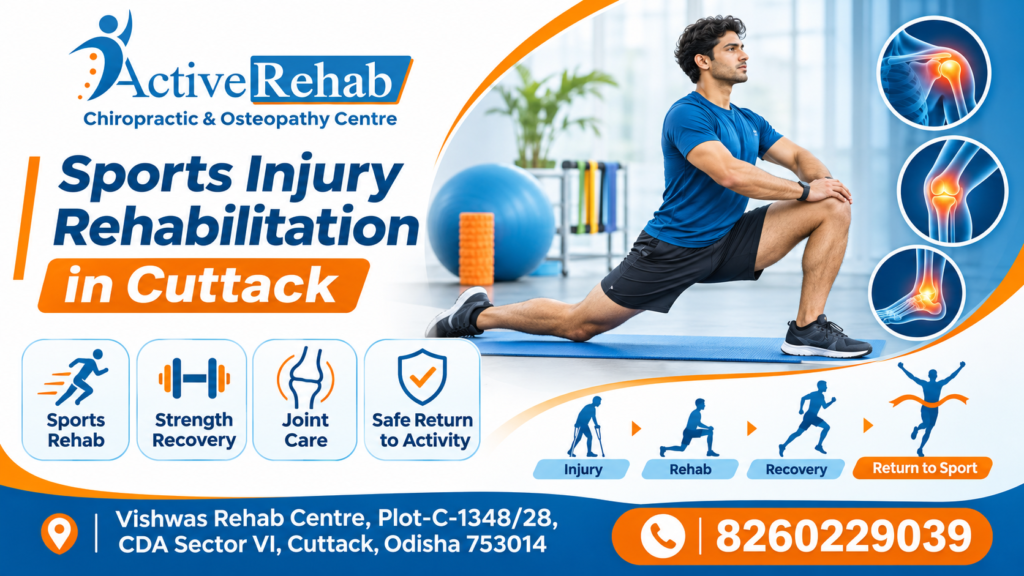
If you are searching for sports injury rehabilitation in Cuttack, it is important to understand that recovery involves more than simply reducing pain. A structured rehabilitation programme should focus on restoring movement, rebuilding strength, improving physical capacity and preparing you to return to your sport safely.
At ActiveRehab Chiropractic & Osteopathy Centre, Cuttack, rehabilitation options may include physiotherapy, exercise-based rehabilitation, manual therapy and individualised movement guidance, depending on the injury and clinical assessment.
What Is Sports Injury Rehabilitation?
Sports injury rehabilitation is a structured process designed to help individuals recover from injuries and regain the physical abilities required for their sport or daily activities.
The programme depends on the type and severity of injury, the tissues involved, the individual’s fitness level and the demands of the sport.
A rehabilitation plan may focus on:
- Managing pain and swelling
- Restoring joint mobility
- Improving muscle flexibility
- Rebuilding strength and endurance
- Improving balance and coordination
- Developing sport-specific movement skills
- Preparing for a gradual return to training and competition
The objective is not only to help the injured area recover but also to address relevant factors that may have contributed to the injury.
Common Sports Injuries That May Require Rehabilitation
Different sports place different demands on the body. Some injuries occur suddenly, while others develop gradually through repetitive loading.
1. Ankle Sprain
An ankle sprain commonly occurs when the foot twists or rolls unexpectedly, stretching or tearing the supporting ligaments.
It is frequently seen in badminton, basketball, football and running.
Common symptoms include:
- Pain around the ankle
- Swelling and tenderness
- Difficulty walking
- Discomfort during jumping or running
- Reduced ankle stability
Rehabilitation may include restoring ankle movement, progressive strengthening, balance training and sport-specific drills.
2. Knee Injuries
Knee injuries are common in sports involving running, jumping, sudden stops and changes in direction.
Examples include ligament injuries, meniscus injuries and patellofemoral pain.
Possible symptoms include:
- Pain while climbing stairs
- Discomfort during squatting
- Swelling around the knee
- Difficulty running or jumping
- A feeling of instability
Some knee injuries require medical or surgical assessment before rehabilitation begins. The programme should be based on the diagnosis.
3. Shoulder Injuries
Shoulder problems are frequently experienced by badminton, tennis, swimming and cricket players.
Repeated overhead movements can contribute to irritation of the rotator cuff tendons and other shoulder structures.
Symptoms may include:
- Pain while raising the arm
- Discomfort during overhead movements
- Reduced shoulder strength
- Difficulty serving or throwing
- Pain during gym exercises
Rehabilitation may involve carefully progressed shoulder mobility, strengthening and sport-specific movement training.
4. Tennis Elbow
Tennis elbow, also known as lateral elbow tendinopathy, causes pain around the outer side of the elbow.
It may affect tennis and badminton players, gym enthusiasts and people performing repetitive gripping activities.
Rehabilitation commonly focuses on appropriate load management and progressive strengthening of the forearm muscles.
5. Hamstring Strain
Hamstring injuries can occur during sprinting, running and sudden acceleration.
Common symptoms include:
- Sudden pain at the back of the thigh
- Muscle tenderness
- Discomfort while walking or running
- Reduced strength
- Difficulty accelerating
Rehabilitation may include progressive hamstring strengthening, mobility work and a gradual return to running.
6. Lower Back and Muscle Strain
Weightlifting, cricket, gym workouts and other physical activities may place considerable demands on the lower back.
Muscle strains and other musculoskeletal conditions can cause discomfort during bending, lifting or twisting.
A proper assessment helps determine the likely source of symptoms and whether additional medical evaluation is necessary.
Why Is Professional Sports Injury Rehabilitation Important?
Returning to sport too early can place excessive stress on healing tissues. At the same time, prolonged inactivity without an appropriate rehabilitation plan may contribute to reduced strength and physical conditioning.
Professional rehabilitation helps guide the recovery process.
1. Identifying the Nature of the Injury
The first step is understanding what has happened.
An assessment may include injury history, pain location, swelling, joint movement, muscle strength and functional limitations.
Where a serious injury is suspected, medical evaluation and appropriate imaging may be required.
2. Restoring Mobility
After an injury, joint movement and flexibility may become restricted.
Appropriate mobility exercises can help restore comfortable movement, depending on the injury and healing stage.
3. Rebuilding Muscle Strength
Muscle strength may reduce following injury or a period of reduced activity.
Progressive strengthening helps rebuild the capacity needed for walking, running, jumping, lifting and sport-specific movements.
4. Improving Balance and Coordination
Balance and coordination are important for activities involving sudden direction changes, landing and single-leg movements.
Rehabilitation may include balance exercises and controlled movement drills to improve functional performance.
5. Preparing for Return to Sport
Returning to normal daily activities does not necessarily mean an athlete is ready for competition.
A rehabilitation programme should gradually introduce sport-specific demands and assess whether the individual can tolerate them safely.
Sports Injury Rehabilitation Treatment at ActiveRehab Cuttack
At ActiveRehab, rehabilitation options are selected according to the patient’s condition, assessment findings and recovery goals.
1. Initial Injury Assessment
The assessment may include:
- Understanding how the injury occurred
- Reviewing previous injuries and medical history
- Evaluating pain and swelling
- Assessing joint mobility
- Checking muscle strength
- Evaluating balance and functional movement
- Identifying activities that aggravate symptoms
If there are signs of a fracture, significant ligament injury or other serious condition, appropriate medical referral may be recommended.
2. Physiotherapy and Exercise Therapy
Physiotherapy plays an important role in sports injury rehabilitation.
Depending on the injury, treatment may include:
- Mobility exercises
- Stretching where appropriate
- Progressive strengthening
- Functional movement training
- Balance and coordination exercises
- Sport-specific rehabilitation drills
Exercises should be progressed according to tissue healing, symptoms and functional ability rather than following the same programme for every patient.
3. Manual Therapy
Selected manual therapy techniques may be used when appropriate to address joint stiffness, muscular discomfort and movement restrictions.
Manual therapy is generally considered an adjunct to an active rehabilitation programme rather than a replacement for exercise and progressive loading.
4. Strength and Conditioning
Athletes need sufficient strength and endurance to meet the physical demands of their sport.
Strengthening may target:
- Core muscles
- Hip and gluteal muscles
- Quadriceps and hamstrings
- Calf muscles
- Shoulder stabilisers
- Forearm muscles
The exercises depend on the injury and the sport involved.
5. Balance and Functional Training
Balance and functional training may be especially useful for athletes recovering from ankle, knee and lower-limb injuries.
Exercises may include:
- Single-leg balance
- Controlled step-ups
- Weight-transfer activities
- Landing mechanics
- Direction-change drills
These activities should only be introduced when the injury is ready for the required level of loading.
6. Sport-Specific Rehabilitation
The final stages of rehabilitation should reflect the athlete’s actual sporting requirements.
For example:
Badminton: Controlled lunges, lateral movement, jumping and landing drills.
Cricket: Throwing progression, running between wickets and bowling or batting-specific movement, as appropriate.
Football: Acceleration, deceleration, controlled kicking and change-of-direction drills.
Running: Gradual progression from walking to jogging, running and sport-specific speed work.
Gym training: Progressive loading, lifting technique and controlled return to previous exercise routines.
How Long Does Sports Injury Rehabilitation Take?
There is no fixed recovery timeline for every sports injury.
Recovery depends on several factors:
- Type of injury
- Severity of tissue damage
- Whether surgery is required
- Previous injury history
- Age and general health
- Physical demands of the sport
- Consistency with the rehabilitation programme
- Response to progressive loading
A mild muscle strain may recover relatively quickly, while significant ligament injuries, tendon injuries or post-operative conditions may require a longer rehabilitation period.
Your rehabilitation plan should be reviewed regularly and adjusted according to progress.
When Can You Return to Sports After an Injury?
Returning to sport should be based on functional readiness rather than pain reduction alone.
Depending on the injury, a healthcare professional may assess:
- Whether pain and swelling are appropriately controlled.
- Whether joint movement is adequate.
- Whether muscle strength has sufficiently recovered.
- Whether balance and coordination are satisfactory.
- Whether running, jumping or sport-specific movements can be performed safely.
- Whether the athlete can tolerate progressive training without a significant symptom flare-up.
For serious injuries, return-to-sport decisions should involve the treating medical or rehabilitation team.
Do not rush back into competition simply because you feel better during everyday activities.
How Can Athletes Reduce the Risk of Sports Injuries?
Although not all sports injuries can be prevented, appropriate preparation and training habits may reduce avoidable risks.
Warm Up Before Training
Begin with light activity and dynamic movements appropriate to your sport before progressing to higher-intensity exercise.
Build Strength Gradually
Strength training can help improve the body’s ability to tolerate sporting demands. Increase training loads progressively.
Avoid Sudden Increases in Training
A sudden increase in exercise duration, intensity or frequency may exceed the body’s current capacity.
Use Appropriate Equipment
Wear suitable footwear and use protective equipment recommended for your sport.
Allow Adequate Recovery
Sleep, rest days and appropriate training recovery are important parts of athletic development.
Pay Attention to Warning Symptoms
Persistent pain, repeated swelling or reduced performance should not be ignored. Seek an appropriate assessment when symptoms continue or worsen.
Why Choose ActiveRehab for Sports Injury Rehabilitation in Cuttack?
ActiveRehab Chiropractic & Osteopathy Centre provides musculoskeletal care and rehabilitation services in Cuttack and Bhubaneswar.
The rehabilitation approach may include:
- Individual injury assessment
- Physiotherapy and exercise rehabilitation
- Progressive strengthening
- Manual therapy when appropriate
- Mobility and movement training
- Balance and coordination exercises
- Guidance for a gradual return to sporting activities
Dr. Ashok P. Kota is a chiropractor with a PG Diploma in Chiropractic from Ackermann College of Chiropractic, Sweden, an osteopath with a PG Diploma in Osteopathy from Ontario College of Osteopathy, Canada, and a sports physiotherapist with over 18 years of experience.
The treatment plan is selected according to the individual’s injury, medical history and functional goals.
Book a Sports Injury Rehabilitation Consultation in Cuttack
Whether you are a badminton player, cricket player, runner, gym enthusiast or recreational athlete, an appropriate assessment can help identify your rehabilitation needs.
If a sports injury is affecting your training, movement or daily activities, consult the team at ActiveRehab in Cuttack.
Clinic: ActiveRehab Chiropractic & Osteopathy Centre
Address: Vishwas Rehab Centre, Plot-C-1348/28, CDA Sector VI, Cuttack, Odisha – 753014.
Contact: +91 8260229039
Website: https://activerehab.in/
Contact the clinic to enquire about an appointment and discuss your sports injury rehabilitation requirements.
Frequently Asked Questions
1. What is sports injury rehabilitation?
Sports injury rehabilitation is a structured programme that helps individuals recover movement, strength, balance and sport-specific function following an injury.
2. Can physiotherapy help athletes recover from sports injuries?
Yes. Physiotherapy may include exercise therapy, progressive strengthening, mobility training, balance exercises and functional rehabilitation, depending on the injury.
3. Which sports injuries require rehabilitation?
Ankle sprains, knee injuries, shoulder problems, tennis elbow, hamstring strains and certain lower-back injuries may benefit from a structured rehabilitation programme.
4. Can I continue playing sports if I have pain?
Continuing to play through pain may aggravate some injuries. The decision depends on the injury and its severity. Seek an assessment if pain persists, swelling develops or movement becomes restricted.
5. How many rehabilitation sessions are required?
The number of sessions varies according to the injury, severity, recovery progress and sporting demands. Your programme should be reviewed regularly.
6. Is sports injury rehabilitation useful after surgery?
Yes. Rehabilitation is often an important part of recovery after procedures involving the knee, shoulder, ankle and other joints. The programme should follow the surgeon’s instructions and appropriate post-operative precautions.
7. Where can I get sports injury rehabilitation in Cuttack?
You can enquire at ActiveRehab Chiropractic & Osteopathy Centre, Vishwas Rehab Centre, Plot-C-1348/28, CDA Sector VI, Cuttack, Odisha. Contact +91 8260229039 for appointment information.
Medical Disclaimer: This article is intended for general educational purposes. It does not replace an individual medical assessment or diagnosis. Serious injuries, suspected fractures, major ligament injuries and neurological symptoms require appropriate medical evaluation.